
JPL
Careers
Education
Science & Technology
JPL Logo
JPL Logo
Image

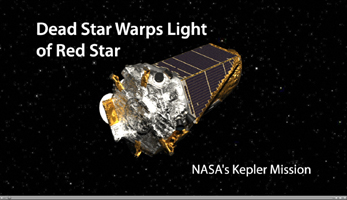
Dead Star Warps Light of Red Star (Artist's Animation)

Jet Propulsion Laboratory https://www.jpl.nasa.gov/ April 4, 2013
This artist's concept depicts an ultra-dense dead star, called a white dwarf, passing in front of a small red star. NASA's planet-hunting Kepler was able to detect gravitational lensing by measuring a strangely subtle dip in the star's brightness.

Click here for animation of PIA16885
Click on the image for the animation

This artist's animation depicts an ultra-dense dead star, called a white dwarf, passing in front of a small red star. As the white dwarf crosses in front, its gravity is so great that it bends and magnifies the light of the red star.

NASA's planet-hunting Kepler space telescope was able to detect this effect, called gravitational lensing, not through direct imaging, but by measuring a strangely subtle dip in the star's brightness.

The red dwarf star is cooler and redder than our yellow sun. Its companion is a white dwarf, the burnt-out core of a star that used to be like our sun. Though the white dwarf is about the same diameter as Earth, 40 times smaller than the red dwarf, it is slightly more massive. The two objects circle around each other, but because the red dwarf is a bit less massive, it technically orbits the white dwarf.

Kepler is designed to look for planets by monitoring the brightness of stars. If planets cross in front of the stars, the starlight will periodically dip. In this case, the passing object turned out to be a white dwarf not a planet. The finding was serendipitous for astronomers because it allowed them to measure the tiny "gravitational lensing" effect of the white dwarf, a rarely observed phenomenon and a test of Einstein's theory of relativity. These data also helped to precisely measure the white dwarf's mass.

JPL managed the Kepler mission's development.

For more information about the Kepler mission, visit: http://www.nasa.gov/kepler.

Download JPG
Download TIFF
Mission
Credit
NASA/JPL-Caltech

Keep Exploring

Comparing the Size of Exoplanet Kepler-1649c and Earth (Illustration)

Kepler Planet 1649c Surface View Artist's Concept

Kepler Planet 1649c Artist's Illustration From Space

K2-288Bb (Artist's Illustration)

K2-138 System Diagram

K2-138 6 Planets Artwork (Artist's Illustration)

Kepler Beyond Planets: Finding Exploding Stars (Type Ia Supernova from a White Dwarf Merger)

Kepler Beyond Planets: Finding Exploding Stars (Type Felt Supernova)

Kepler Beyond Planets: Finding Exploding Stars (Core Collapse Supernova)

Kepler Beyond Planets: Finding Exploding Stars (Type Ia Supernova from a White Dwarf Stealing Matter)

About JPL
Who We Are
Directors
Careers
Internships
The JPL Story
JPL Achievements
Documentary Series
JPL Annual Report
Executive Council
Missions
Current
Past
Future
All
News
All
Earth
Solar System
Stars and Galaxies
Eyes on the News
Subscribe to JPL News
Galleries
Images
Videos
Audio
Podcasts
Apps
Visions of the Future
Slice of History
Robotics at JPL
Events
Lecture Series
Speakers Bureau
Calendar
Visit
Public Tours
Virtual Tour
Directions and Maps
Topics
JPL Life
Solar System
Mars
Earth
Climate Change
Exoplanets
Stars and Galaxies
Robotics
More
Asteroid Watch
NASA's Eyes Visualizations
Universe - Internal Newsletter
Social Media
Accessibility at NASA
Contact Us
Get the Latest from JPL
Follow Us

JPL is a federally funded research and development center managed for NASA by Caltech.

More from JPL
Careers
Education
Science & Technology
Acquisition
JPL Store
Careers
Education
Science & Technology
Acquisition
JPL Store
Related NASA Sites
Basics of Spaceflight
NASA Kids Science - Earth
Earth / Global Climate Change
Exoplanet Exploration
Mars Exploration
Solar System Exploration
Space Place
NASA's Eyes Visualization Project
Voyager Interstellar Mission
NASA
Caltech
Privacy
Image Policy
FAQ
Feedback
Version: v3.1.0 - 9d64141
Site Managers:Emilee Richardson, Alicia Cermak
Site Editors:Naomi Hartono, Steve Carney
CL#:21-0018