

JPL
Careers
Education
Science & Technology
JPL LogoJPL Logo
Education
NASA OSTEM
JPL LogoJPL Logo
Education
Eclipsing Enigma: A ‘Pi in the Sky’ Math Challenge

Lesson .

.

Eclipsing Enigma: A ‘Pi in the Sky’ Math Challenge

Jet Propulsion Laboratory https://www.jpl.nasa.gov/ Last Updated: Sept. 26, 2025
Subject
Math
Grade Levels
7, 9-12
Time Required
Under 30 mins
Standards .
Math Standards (CCSS - Math)
.

Use proportional relationships to solve multistep ratio and percent problems.

Use congruence and similarity criteria for triangles to solve problems and to prove relationships in geometric figures.

Overview

The "Pi in the Sky" math challenge gives students a chance to take part in recent discoveries and upcoming celestial events, all while using math and pi just like NASA scientists and engineers. In this problem from the 10th set, students use pi to figure out how much of the Sun’s disk will be covered by the Moon during an eclipse and whether it’s a total or annular eclipse.

Materials

  • Pi in the Sky 10: Eclipsing Enigma worksheet – download PDF (for best results, download and print from Adobe Reader)
  • Pi in the Sky 10: Eclipsing Enigma answer key – download PDF

Background
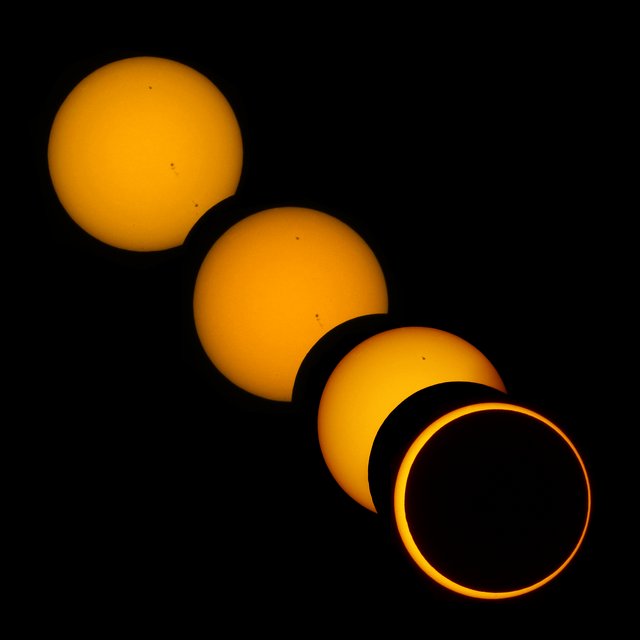
This image sequence shows an annular solar eclipse from May 2012. The bottom right frame illustrates the distinctive ring, or "annulus," of such eclipses. A similar eclipse will be visible from the South Pacific on May 10, 2013. Credits: Brocken Inaglory, CC BY-SA 3.0, via Wikimedia Commons

Eclipsing Enigma

On Oct. 14, 2023, a solar eclipse will be visible across North and South America, as the Moon passes between Earth and the Sun, blocking the Sun's light from our perspective. Because Earth’s orbit around the Sun and the Moon’s orbit around Earth are not perfect circles, the distances between them change throughout their orbits. Depending on those distances, the Sun's disk area might be fully or only partially blocked during a solar eclipse. In Eclipsing Enigma, students get a sneak peek at what to expect in October by using pi to determine how much of the Sun’s disk will be eclipsed by the Moon and whether to expect a total or annular eclipse.

educators.

Teachable Moments: 10 Years of NASA's Pi Day Challenge

Learn more about pi, the history of Pi Day, and the science behind the 2023 NASA Pi Day Challenge.

Procedures

Eclipsing Enigma

A solar eclipse occurs when the Moon passes between Earth and the Sun, fully or partially blocking the Sun's light from our perspective. Because Earth’s orbit around the Sun and the Moon’s orbit around Earth are not perfect circles, the distances between them change throughout their orbits. During a total eclipse, the distances are such that the Moon covers all of the Sun's disk area. When the Moon is farther from Earth during an eclipse, it leaves a glowing ring of sunlight shining around the Moon, resulting in an annular eclipse.

On Oct. 14, 2023, a solar eclipse will be visible across North and South America. The Sun, with a radius of 695,700 km, will be 148,523,036 km from Earth. The Moon, with a radius of 1,737 km, will be 388,901 km from Earth.

What percentage of the Sun’s disk area will be obscured by the Moon?

Will the eclipse be an annular eclipse or total eclipse?

› Learn more about the 2023 solar eclipse

On the left side of the illustration is the sun. Two yellow light beams from the top of the sun and two from the bottom of the sun extend diagonally toward the lower right and upper right, respectively, where they intercept the moon before continuing t...

Assessment

Illustrated answer key for the Eclipsing Enigma problem.

Extensions

educators.

Pi Day Challenge Lessons

Here's everything you need to bring the NASA Pi Day Challenge into the classroom.

students.

NASA Pi Day Challenge

In this challenge, students can use pi to solve some of the same problems faced by NASA scientists and engineers.

educators.

National Council of Teachers of Mathematics: Notice and Wonder

Creative brainstorming through noticing and wondering encourages student participation, engagement, and students' understanding of the NASA Pi Day Challenge.

Features

students.

How Many Decimals of Pi Do We Really Need?

While you may have memorized more than 70,000 digits of pi, world record holders, a JPL engineer explains why you really only need a tiny fraction of that for most calculations.

students.

Slideshow: 18 Ways NASA Uses Pi

Whether it's sending spacecraft to other planets, driving rovers on Mars, finding out what planets are made of or how deep alien oceans are, pi takes us far at NASA. Find out how pi helps us explore space.

Related Lessons for Educators

educators.

Modeling an Asteroid

Lead a discussion about asteroids and their physical properties, then have students mold their own asteroids out of clay.

educators.

Math Rocks: A Lesson in Asteroid Dynamics

Students use math to investigate a real-life asteroid impact.

Related Activities for Students

students.

What's That Space Rock?

Find out how to tell the difference between asteroids, comets, meteors, meteorites and other bodies in our solar system.

Multimedia

students.

Downloads

Can't get enough pi? Download this year's NASA Pi Day Challenge graphics, including mobile phone and desktop backgrounds:

students.

Infographic: Planet Pi

This poster shows some of the ways NASA scientists and engineers use the mathematical constant pi (3.14) and includes common pi formulas.

Recursos en español

students.

18 Maneras en Que la NASA Usa Pi

Pi nos lleva lejos en la NASA. Estas son solo algunas de las formas en que pi nos ayuda a explorar el espacio.

Facts and Figures

  • Eclipse Facts & Safety

Websites

  • 2023 Eclipse
K-12 Resources
Education Resources
Lesson Plans
Student Projects
Teachable Moments
Collections
Internships
JPL Internships
Explore Programs & Apply
Internships FAQ
News & Events
All Education News
All Education Events
About
JPL Education
K-12 Education
Higher Education
Informal Education
NASA OSTEM
Get the Latest from JPL
Follow JPL Education
More from JPL
About JPL
JPL News
Missions
Images
Virtual Tour
Careers
About JPL
JPL News
Missions
Images
Virtual Tour
Careers
Related NASA Education Sites
Space Place
Climate Kids
Kids' Club
Space Math
Universe of Learning
STEMonstrations
Basics of Spaceflight
NASA’s Eyes Interactives
NASA
Caltech
Privacy
Image Policy
FAQ
Feedback
Version: v3.1.0 - 409b2d2
Site Managers:David Seidel, Ota Lutz
Site Editor:Kim Orr