


Teachable Moment .
.5 min readTake Math to Mars and Beyond With NASA's Pi Day Challenge
Update: March 15, 2021 – The answers to the 2021 NASA Pi Day Challenge are here!
In the News
As March 14 approaches, it’s time to get ready to celebrate Pi Day! It’s the annual holiday that pays tribute to the mathematical constant pi – the number that results from dividing any circle's circumference by its diameter.
Pi Day comes around only once a year, giving us a reason to chow down on our favorite sweet and savory pies while we appreciate the mathematical marvel that helps NASA explore Earth, the solar system, and beyond. There’s no better way to observe this day than by getting students exploring space right along with NASA by doing the math in our Pi Day Challenge. Keep reading to find out how students – and you – can put their math mettle to the test and solve real problems faced by NASA scientists and engineers as they explore the cosmos!
How It Works
Dividing any circle’s circumference by its diameter gives us pi, which is often rounded to 3.14. However, pi is an irrational number, meaning its decimal representation goes on forever and never repeats. Pi has been calculated to 50 trillion digits, but NASA uses far fewer for space exploration.

Some people may think that a circle has no points. In fact, a circle does have points, and knowing what pi is and how to use it is far from pointless. Pi is used for calculating the area and circumference of circular objects and the volume of shapes like spheres and cylinders. So it's useful for everyone from farmers storing crops in silos to manufacturers of water storage tanks to people who want to find the best value when ordering a pizza. At NASA, we use pi to find the best place to touch down on Mars, study the health of Earth's coral reefs, measure the size of a ring of planetary debris light years away, and lots more.
In the United States, one format to write March 14 is 3.14, which is why we celebrate on that date. In 2009, the U.S. House of Representatives passed a resolution officially designating March 14 as Pi Day and encouraging teachers and students to celebrate the day with activities that teach students about pi. And you're in luck, because that's precisely what the NASA Pi Day Challenge is all about.
The Science Behind the 2021 NASA Pi Day Challenge
This year, the NASA Pi Day Challenge offers up four brain-ticklers that will require students to use pi to collect samples from an asteroid, fly a helicopter on Mars for the first time, find efficient ways to talk with distant spacecraft, and study the forces behind Earth's beautiful auroras.
Learn more about the science and engineering behind the problems below or click the link below to jump right into the challenge. Be sure to check back on March 15 for the answers to this year’s challenge.


Sample Science
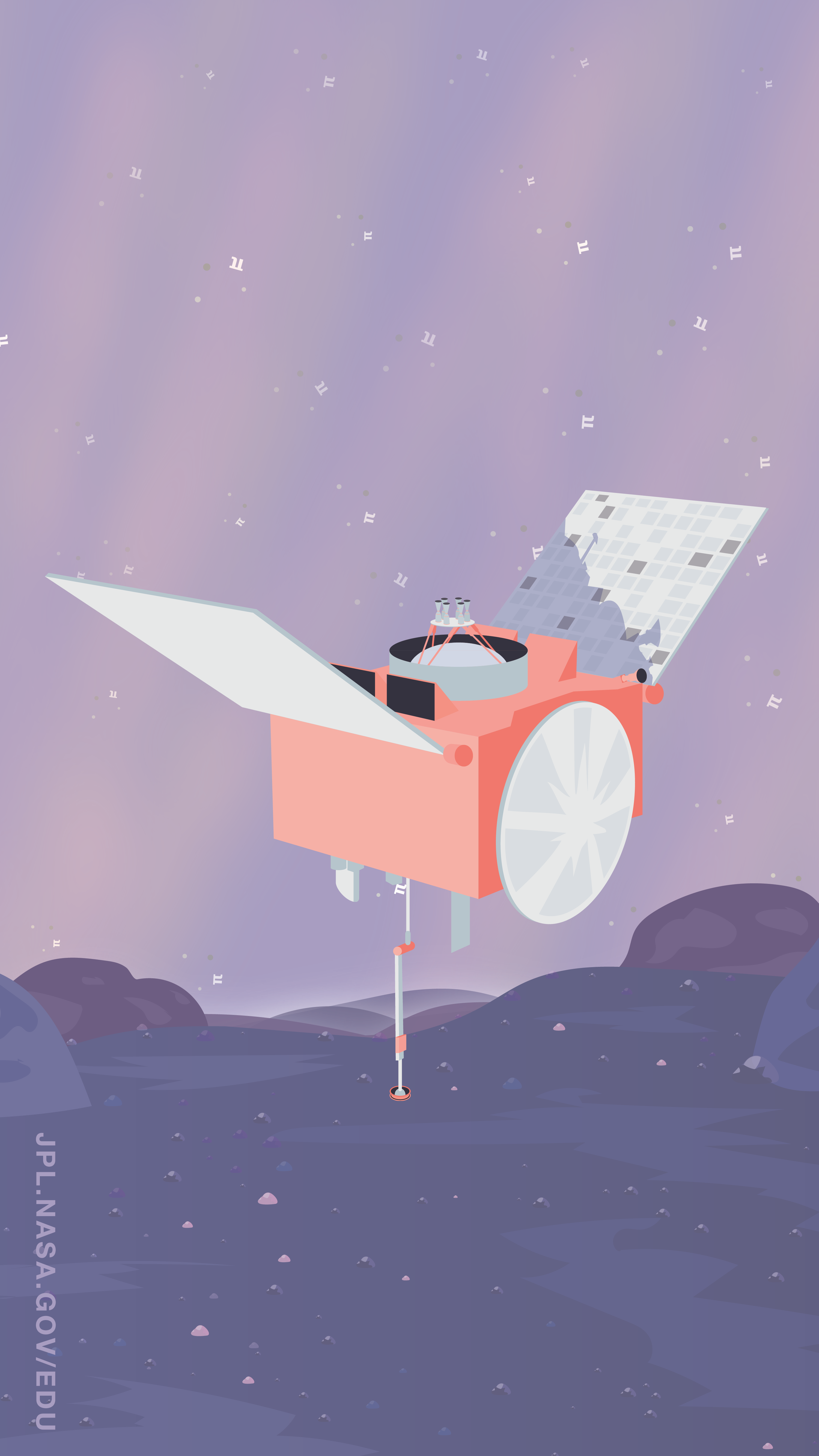
NASA’s OSIRIS-REx mission has flown to an asteroid and collected a sample of surface material to bring back to Earth. (It will arrive back at Earth in 2023.) The mission is designed to help scientists understand how planets form and add to what we know about near-Earth asteroids, like the one visited by OSIRIS-REx, asteroid Bennu. Launched in 2016, OSIRIS-REx began orbiting Bennu in 2018 and successfully performed its maneuver to retrieve a sample on October 20, 2020. In the Sample Science problem, students use pi to determine how much of the spacecraft's sample-collection device needs to make contact with the surface of Bennu to meet mission requirements for success.

This mosaic of Bennu was created using observations made by NASA’s OSIRIS-REx spacecraft that was in close proximity to the asteroid for over two years.
Whirling Wonder
Joining the Perseverance rover on Mars is the first helicopter designed to fly on another planet. Named Ingenuity, the helicopter is a technology demonstration, meaning it's a test to see if a similar device could be used for a future Mars mission. To achieve the first powered flight on another planet, Ingenuity must spin its blades at a rapid rate to generate lift in Mars’ thin atmosphere. In Twirly Whirly, students use pi to compare the spin rate of Ingenuity’s blades to those of a typical helicopter on Earth.

NASA’s Perseverance Mars rover took a selfie with the Ingenuity helicopter, seen here about 13 feet (3.9 meters) from the rover. This image was taken by the WASTON camera on the rover’s robotic arm on April 6, 2021, the 46th Martian day, or sol, of the mission.
Signal Solution
NASA uses radio signals to communicate with spacecraft across the solar system and in interstellar space. As more and more data flows between Earth and these distant spacecraft, NASA needs new technologies to improve how quickly data can be received. One such technology in development is Deep Space Optical Communications, which will use near-infrared light instead of radio waves to transmit data. Near-infrared light, with its higher frequency than radio waves, allows for more data to be transmitted per second. In Signal Solution, students can compare the efficiency of optical communication with radio communication, using pi to crunch the numbers.

Force Field
Earth’s magnetic field extends from within the planet to space, and it serves as a protective shield, blocking charged particles from the Sun. Known as the solar wind, these charged particles of helium and hydrogen race from the Sun at hundreds of miles per second. When they reach Earth, they would bombard our planet and orbiting satellites were it not for the magnetic field. Instead, they are deflected, though some particles become trapped by the field and are directed toward the poles, where they interact with the atmosphere, creating auroras. Knowing how Earth’s magnetic field shifts and how particles interact with the field can help keep satellites in safe orbits. In Force Field, students use pi to calculate how much force a hydrogen atom would experience at different points along Earth’s magnetic field.

Teach It
Pi Day is a fun and engaging way to get students thinking like NASA scientists and engineers. By solving the NASA Pi Day Challenge problems below, reading about other ways NASA uses pi, and doing the related activities, students can see first hand how math is an important part of STEM.
Education Resources


About the Author

Lyle Tavernier
Educational Technology Specialist, NASA-JPL Education Office