

JPL
Careers
Education
Science & Technology
JPL LogoJPL Logo
Education
NASA OSTEM
JPL LogoJPL Logo
Education
Lunar Logic: A 'Pi in the Sky' Math Challenge

Lesson .

.

Lunar Logic: A 'Pi in the Sky' Math Challenge

Jet Propulsion Laboratory https://www.jpl.nasa.gov/ Last Updated: June 20, 2025
Subject
Math
Grade Levels
7-8
Time Required
30 - 60 mins
Standards .
Math Standards (CCSS - Math)
.

Know the formulas for the area and circumference of a circle and use them to solve problems; give an informal derivation of the relationship between the circumference and area of a circle.

Overview

The "Pi in the Sky" math challenge gives students a chance to take part in recent discoveries and upcoming celestial events, all while using math and pi just like NASA scientists and engineers. In this problem from the ninth set, students use the mathematical constant pi to calculate the area covered by a laser used to detect frost on the Moon's surface.

Materials

  • Pi in the Sky 9: Lunar Logic worksheet – download PDF
  • Pi in the Sky 9: Lunar Logic answer key – download PDF (also available as a text-only doc)

Background
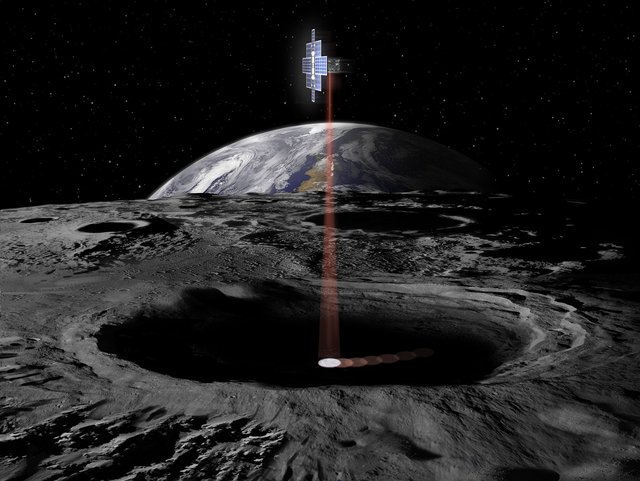
An spacecraft orbiting the Moon shines a laser into a dark crater.
This artist's concept shows the Lunar Flashlight spacecraft, a six-unit CubeSat designed to search for ice on the Moon's surface using special lasers. › Full image details.
Credit: NASA/JPL-Caltech

Lunar Logic

NASA’s Lunar Flashlight mission is a small satellite that will seek out signs of frost in deep, permanently shadowed craters around the Moon’s south pole. By sending infrared laser pulses to the surface and measuring how much light is reflected back, scientists can determine which areas of the lunar surface contain frost and which are dry. Knowing the locations of water-ice on the Moon could be key for future crewed missions to the Moon, when water will be a precious resource. In Lunar Logic, students use pi to find out how much surface area Lunar Flashlight will measure with a single pulse from one of its lasers.

educators.

Teachable Moments: Pi Goes to Infinity and Beyond in NASA Challenge

Learn more about about pi, the history of Pi Day before, and the science behind the 2022 NASA Pi Day Challenge.

Procedures

Lunar Logic

NASA’s Lunar Flashlight mission will observe and map the location of frost within permanently shadowed craters in the Moon’s south polar region. Knowing how much frost is in these craters and where to find it can help us prepare for extended missions on the Moon, when water will be a valuable resource.

The spacecraft, a backpack-size cubesat, will collect data during 10 orbits over a two-month period, making repeated measurements over multiple points to map ice in these dark craters. To take measurements, Lunar Flashlight will send infrared laser pulses to the surface of the Moon and measure the signal that is reflected. The amount of light that is reflected back will help scientists determine where the lunar surface is dry and where it contains water-ice.

At 20 km altitude, the spacecraft's infrared lasers have a radius of 17.5 meters when they reach the surface of the Moon.

How much area do they cover in a single pulse?

› Learn more about the Lunar Flashlight mission

The Lunar Flashlight spacecraft shines a laser into a dark crater on the Moon, lighting up a circular area on the surface. Earth sits just beyond the horizon on the Moon’s south pole, a perspective that makes Earth appear as if it has been flipped 180 ...

Assessment

Illustrated answer key for the Lunar Logic problem

› Download text-only answer key (doc)

Extensions

Participate

Join the conversation and share your Pi Day Challenge answers with @NASAJPL_Edu on social media using the hashtag #NASAPiDayChallenge

educators.

Pi Day Challenge Lessons

Here's everything you need to bring the NASA Pi Day Challenge into the classroom.

students.

Slideshow: NASA Pi Day Challenge

The entire NASA Pi Day Challenge collection can be found in one, handy slideshow for students.

Blogs and Features

students.

How Many Decimals of Pi Do We Really Need?

While you may have memorized more than 70,000 digits of pi, world record holders, a JPL engineer explains why you really only need a tiny fraction of that for most calculations.

students.

Slideshow: 18 Ways NASA Uses Pi

Whether it's sending spacecraft to other planets, driving rovers on Mars, finding out what planets are made of or how deep alien oceans are, pi takes us far at NASA. Find out how pi helps us explore space.

Related Lessons for Educators

educators.

Whip Up a Moon-Like Crater

Whip up a moon-like crater with baking ingredients as a demonstration for students.

Related Activities for Students

students.

Look at the Moon! Journaling Project

Draw what you see in a Moon Journal and see if you can predict the moon phase that comes next.

Multimedia

students.

Downloads

Can't get enough pi? Download this year's NASA Pi Day Challenge graphics, including mobile phone and desktop backgrounds:

students.

Infographic: Planet Pi

This poster shows some of the ways NASA scientists and engineers use the mathematical constant pi (3.14) and includes common pi formulas.

Recursos en español

students.

18 Maneras en Que la NASA Usa Pi

Pi nos lleva lejos en la NASA. Estas son solo algunas de las formas en que pi nos ayuda a explorar el espacio.

Facts and Figures

  • Earth's Moon

Missions and Instruments

  • Lunar Flashlight

Websites

  • NASA Science: Earth's Moon
  • Artemis
K-12 Resources
Education Resources
Lesson Plans
Student Projects
Teachable Moments
Collections
Internships
JPL Internships
Explore Programs & Apply
Internships FAQ
News & Events
All Education News
All Education Events
About
JPL Education
K-12 Education
Higher Education
Informal Education
NASA OSTEM
Get the Latest from JPL
Follow JPL Education
More from JPL
About JPL
JPL News
Missions
Images
Virtual Tour
Careers
About JPL
JPL News
Missions
Images
Virtual Tour
Careers
Related NASA Education Sites
Space Place
Climate Kids
Kids' Club
Space Math
Universe of Learning
STEMonstrations
Basics of Spaceflight
NASA’s Eyes Interactives
NASA
Caltech
Privacy
Image Policy
FAQ
Feedback
Version: v3.1.0 - 409b2d2
Site Managers:David Seidel, Ota Lutz
Site Editor:Kim Orr