
JPL
Careers
Education
Science & Technology
JPL Logo
JPL Logo

Mission to Saturn

Cassini-Huygens

MISSION ACCOMPLISHED: After two decades in space, NASA's Cassini spacecraft reached the end of its remarkable journey of exploration.

Visit Mission Website
Cassini Foreground

Mission Statistics

Launch Date

Oct. 15, 1997

Type

Orbiter, Flyby Spacecraft

Target

Saturn

Status

Past

About the mission

MISSION ACCOMPLISHED: After two decades in space, NASA's Cassini spacecraft reached the end of its remarkable journey of exploration.
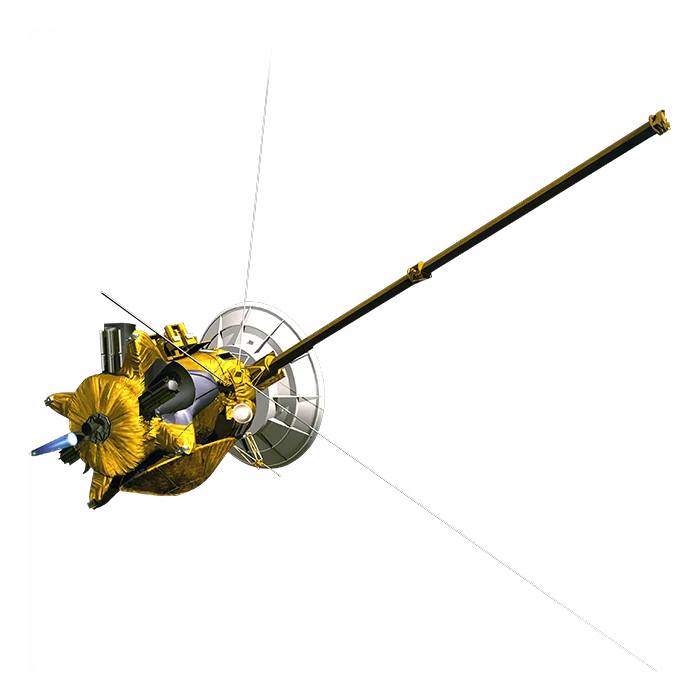
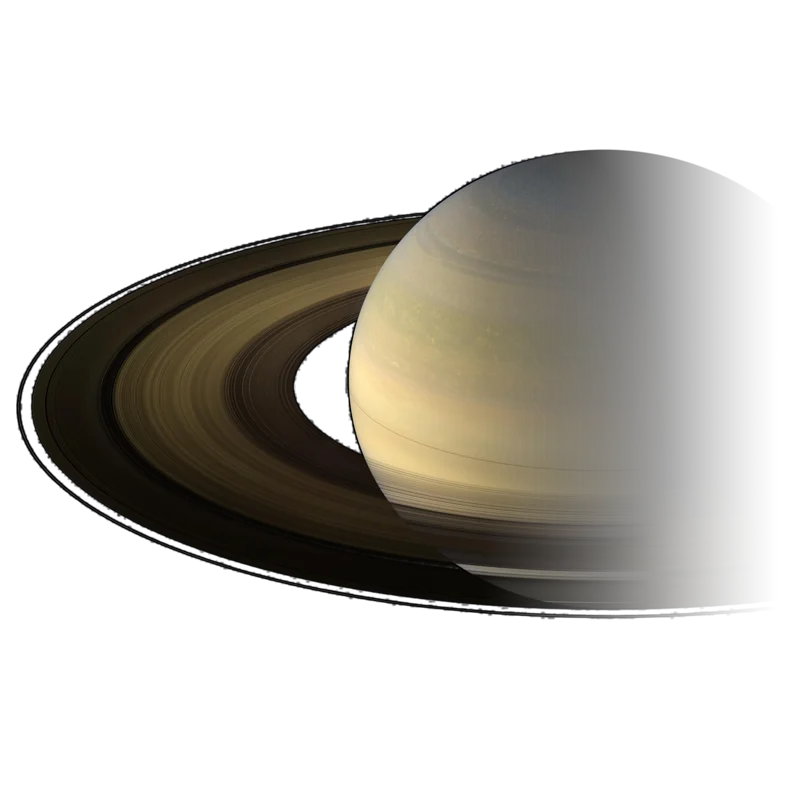
Orbiting the ringed planet Saturn and its numerous moons, the Cassini spacecraft had been a keystone of exploration of the Saturnian system and the properties of gaseous planets in our solar system.

A joint endeavor of NASA, the European Space Agency, or ESA, and the Italian Space Agency, Cassini launched in 1997 along with ESA's Huygens probe. The spacecraft contributed to studies of Jupiter for six months in 2000 before reaching its destination, Saturn, in 2004 and starting a string of flybys of Saturn's moons. That same year it released the Huygens probe on Saturn's moon Titan to conduct a study of the moon's atmosphere and surface composition. In its second extended mission, Cassini made the first observations of a complete seasonal period for Saturn and its moons, flew between the rings and descended into the planet's atmosphere.

Instruments
  • Ion and neutral mass spectrometer
  • Visible and infrared mapping spectrometer
  • Composite infrared spectrometer
  • Cosmic dust analyzer
  • Radio and plasma wave instrument
  • Cassini plasma spectrometer
  • Ultraviolet imaging spectrograph
  • Magnetospheric imaging instrument
  • Dual technique magnetometer
  • Radio science subsystem

Mission Highlights

Dec. 30, 2000

Cassini-Huygens takes a six-month swing by Jupiter to pick up speed for its journey to Saturn and collaborates with NASA's Galileo spacecraft to study the Jovian system.

June 30, 2004

Cassini arrives at Saturn.

Dec. 13, 2004

Cassini-Huygens makes its first flyby of a Saturnian moon, two in fact: Titan and Dione. For a full list of Cassini's flybys since 2004, visit: http://saturn.jpl.nasa.gov/mission/flybys/

Dec. 24, 2004

The Cassini spacecraft releases the European Space Agency-built Huygens probe at Saturn's moon Titan.

Jan. 14, 2005

The Huygens probe makes its descent through Titan's atmosphere to sample the chemical composition and surface properties of the Saturnian moon.

June 1, 2008

Cassini completes its primary mission to explore the Saturn system and begins its mission extension (Cassini Equinox Mission).

Sept. 1, 2010

Cassini completes its extended mission (Cassini Equinox Mission) and begins its second mission extension (Cassini Solstice Mission), which goes through 2017 and will make the first observations of a complete seasonal period for Saturn and its moons. Learn more at http://saturn.jpl.nasa.gov/index.cfm .

Dec. 1, 2011

Cassini uses its synthetic aperture radar to obtain the highest resolution images yet of Saturn's moon Enceladus.

Dec. 1, 2012

Cassini uses its visual and infrared mapping spectrometer, or VIMS, instrument to track the transit of Venus -- a first for a spacecraft beyond Earth orbit. The exercise is to test the feasibility of using Cassini's VIMS to observe planets outside our solar system.

March 1, 2013

Cassini makes its last flyby of Saturn's moon Rhea, probing the internal structure of the moon by measuring the gravitational pull of Rhea against the spacecraft's steady radio link to NASA's Deep Space Network here on Earth.

July 1, 2013

Cassini images a backlit Saturn to examine the planet's rings in fine detail and captures a pixel-size Earth in the process. In a campaign to raise awareness about the photo shoot, NASA encourages Earthlings to go outside and wave at Saturn.

April 22, 2017

Closest flyby of Titan moon.

April 23, 2017

First Grand Finale orbit begins.

April 26, 2017

First ringplane crossing. NASA's Cassini spacecraft is back in contact with Earth after its successful first-ever dive through the narrow gap between the planet Saturn and its rings.

Sept. 15, 2017

End of Mission as Cassini begins Final Entry into Saturn's Atmosphere.
Saturn

More about Solar System

Image.

Odyssey Team Celebrates on a Global Map of Mars

News.

NASA’s Perseverance, Curiosity Panoramas Capture Two Sides of Mars

Image.

Six Years of Curiosity’s Wheels on the Move

Image.

Curiosity Captures a 360-Degree View at ‘Nevado Sajama’

News.

NASA’s Curiosity Finds Organic Molecules Never Seen Before on Mars

Infographic.

Pi in the Sky: A Pi Day Infographic

News.

NASA Shuts Off Instrument on Voyager 1 to Keep Spacecraft Operating

Image.

JPL’s ‘Lucky Peanuts’ Before Artemis II Launch

Image.

Watching Over the Deep Space Network Before Artemis II Signal Acquisition

Image.

Supporting Artemis II From JPL’s Space Flight Operations Facility

  • › Mission Website
  • › Press Kit
  • › Arrival Press Kit
  • › Fact Sheet
  • › Cassini on Twitter

Explore Other Missions

GRAIL

Genesis

Europa Clipper

Juno

Galileo

Infrared Astronomical Satellite

Mariner 1

Dawn

Magellan

Europa Lander

About JPL
Who We Are
Directors
Careers
Internships
The JPL Story
JPL Achievements
Documentary Series
JPL Annual Report
Executive Council
Missions
Current
Past
Future
All
News
All
Earth
Solar System
Stars and Galaxies
Eyes on the News
Subscribe to JPL News
Galleries
Images
Videos
Audio
Podcasts
Apps
Visions of the Future
Slice of History
Robotics at JPL
Events
Lecture Series
Speakers Bureau
Calendar
Visit
Public Tours
Virtual Tour
Directions and Maps
Topics
JPL Life
Solar System
Mars
Earth
Climate Change
Exoplanets
Stars and Galaxies
Robotics
More
Asteroid Watch
NASA's Eyes Visualizations
Universe - Internal Newsletter
Social Media
Accessibility at NASA
Contact Us
Get the Latest from JPL
Follow Us

JPL is a federally funded research and development center managed for NASA by Caltech.

More from JPL
Careers
Education
Science & Technology
Acquisition
JPL Store
Careers
Education
Science & Technology
Acquisition
JPL Store
Related NASA Sites
Basics of Spaceflight
NASA Kids Science - Earth
Earth / Global Climate Change
Exoplanet Exploration
Mars Exploration
Solar System Exploration
Space Place
NASA's Eyes Visualization Project
Voyager Interstellar Mission
NASA
Caltech
Privacy
Image Policy
FAQ
Feedback
Version: v3.1.0 - 409b2d2
Site Managers:Emilee Richardson, Alicia Cermak
Site Editors:Naomi Hartono, Steve Carney
CL#:21-0018