JPL
Careers
Education
Science & Technology
JPL Logo
JPL Logo
Climate Change
.2 min read

NASA Study Refines Projections for Thwaites Glacier

Jet Propulsion Laboratory https://www.jpl.nasa.gov/ Oct. 20, 2026
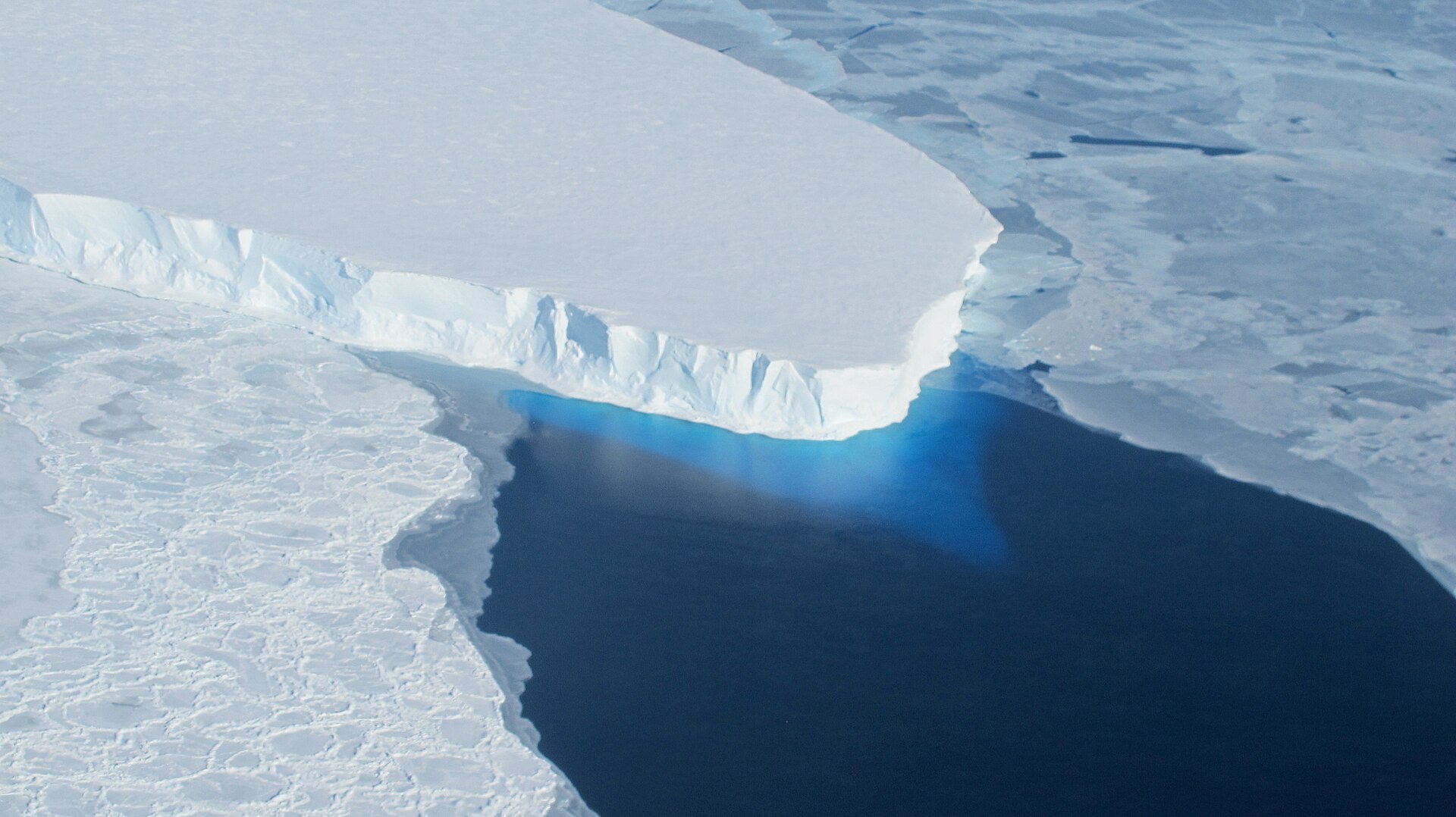
An ice glacier protrudes into water.

Antarctica’s Thwaites Glacier pictured in 2014. A new study using a computer model developed by NASA’s Jet Propulsion Laboratory along with the University of California, Irvine, and Dartmouth College, finds the glacier could contribute more to sea level-rise than previously predicted by some other estimates.

Credit: NASA/OIB/Jeremy Harbeck

While the glacier is a major contributor to global sea level rise, projecting its long-term impacts has proved challenging.

A new study using a computer model developed by NASA’s Jet Propulsion Laboratory in Southern California, along with the University of California, Irvine, and Dartmouth College, finds Antarctica’s Thwaites Glacier could contribute more to sea level rise by the end of the century than some previous estimates. In some model simulations, the glacier’s contribution was as much as twice current projections.

While the glacier is a major contributor to global sea level rise, projecting its long-term impacts has proved challenging because of complex processes. The study, published Oct. 12 in Nature Communications, reduces that uncertainty by homing in on the transitional area where glacial ice is no longer bound to the land and, instead, is afloat.

Existing ice sheet models typically treat this transitional area as a distinct boundary, commonly labeled grounding lines. The researchers’ model instead, accounts for these areas as grounding zones — areas where seawater penetrates several miles beneath glacial grounded ice, lifting the ice during tidal cycles that can generate instabilities. The process introduces warmer seawater to the grounded ice, accelerating its melt and destabilizing the glacier more than a distinct line would allow.

Incorporating grounding zones improved the accuracy of the model’s ability to simulate glacial retreat. The model matched historical satellite data dating back to the 1990s four times more closely than models that don’t include this factor.

The researchers believe this model could provide more reliable information on glacier dynamics, informing coastal regions most impacted by higher sea levels.

Get the JPL Newsletter

From Mars to the Milky Way — never miss a discovery! Delivered straight to your inbox.


Email Groups

Media Contacts

Andrew Good / Andrew Wang

Jet Propulsion Laboratory, Pasadena, Calif.

818-393-2433 / 626-379-6874

andrew.c.good@jpl.nasa.gov / andrew.wang@jpl.nasa.gov

Written by Kristy Hutchings

2026-072

Related News

Earth.

How 2 US, European Satellites Are Studying Hurricanes During El Niño

Climate Change.

NASA Scientists Take to Air and Space to Study Arctic Sea Ice

Earth.

NASA, Partners Share First Data From New US-European Sea Satellite

Earth.

NASA, SpaceX Launch US-European Satellite to Monitor Earth’s Oceans

Earth.

NASA, European Partners Set to Launch Sentinel-6B Earth Satellite

Earth.

NASA Sets Launch Coverage for International Ocean Tracking Mission

Earth.

6 Things to Know From NASA About New US, European Sea Satellite

Earth.

New NASA-ESA Sea Level Satellite Arrives at California Launch Site

Climate Change.

NASA Takes to the Air to Study Wildflowers

Earth.

How US-Indian NISAR Satellite Will Offer Unique Window on Earth

About JPL
Who We Are
Directors
Careers
Internships
The JPL Story
JPL Achievements
Documentary Series
JPL Annual Report
Executive Council
Missions
Current
Past
Future
All
News
All
Earth
Solar System
Stars and Galaxies
Eyes on the News
Subscribe to JPL News
Galleries
Images
Videos
Audio
Podcasts
Apps
Visions of the Future
Slice of History
Robotics at JPL
Events
Lecture Series
Speakers Bureau
Calendar
Explore JPL
Visit
Public Tours
Virtual Tour
Directions and Maps
Explore JPL
Topics
JPL Life
Solar System
Mars
Earth
Climate Change
Exoplanets
Stars and Galaxies
Robotics
More
Asteroid Watch
NASA's Eyes Visualizations
Universe - Internal Newsletter
Social Media
Accessibility at NASA
Contact Us
Get the Latest from JPL
Follow Us

JPL is a federally funded research and development center managed for NASA by Caltech.

More from JPL
Careers
Education
Science & Technology
Acquisition
JPL Store
Careers
Education
Science & Technology
Acquisition
JPL Store
Related NASA Sites
Basics of Spaceflight
NASA Kids Science - Earth
Earth / Global Climate Change
Exoplanet Exploration
Mars Exploration
Solar System Exploration
Space Place
NASA's Eyes Visualization Project
Voyager Interstellar Mission
NASA
Caltech
Privacy
Image Policy
FAQ
Feedback
Version: v3.2.0 - 38db01a
Site Managers:Emilee Richardson, Alicia Cermak
Site Editors:Steve Carney
CL#:21-0018