
Interstellar probes. Lunar drones. Helicopters on Mars.
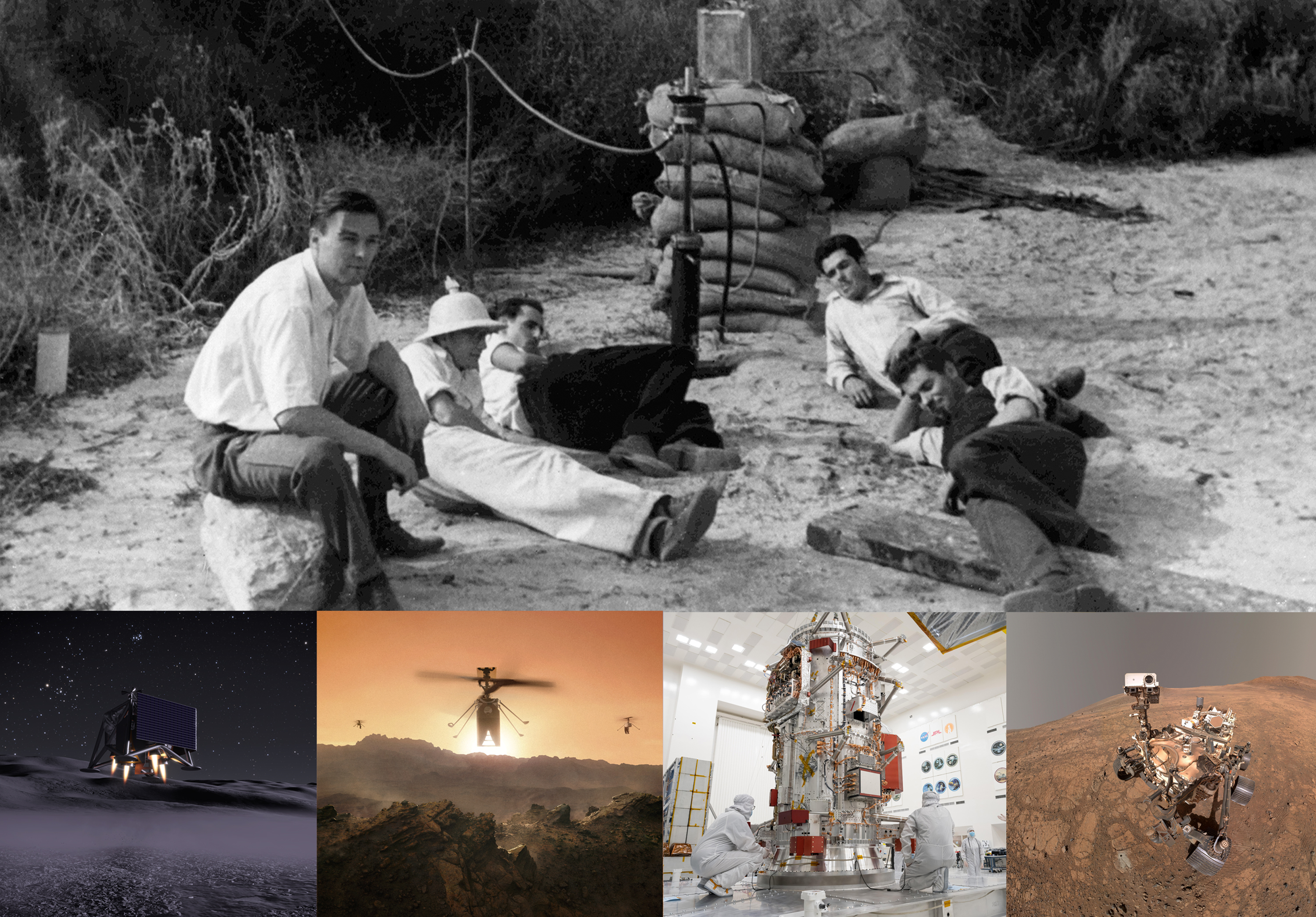
When a group of Caltech graduate students and enthusiasts began conducting rocket-propulsion tests in Pasadena’s Arroyo Seco on Oct. 31, 1936, they had no idea that their work marked the inception of the Jet Propulsion Laboratory. Ninety years later, the Lab, now managed by Caltech for NASA, isn’t only celebrating the long line of historic firsts accomplished here; it’s paving the way for many to come.
Initially a contractor for the U.S. Army, JPL launched America’s first satellite, Explorer 1 in 1958. But rather than just orbiting Earth like the Soviet Union’s Sputnik, Explorer 1 became the first spacecraft to conduct science, thanks to an onboard Geiger counter that discovered the protective radiation belts encircling Earth.
The Lab joined part of the newly formed NASA that same year. Within six years, in 1964, JPL sent the first U.S. mission to the Moon, Ranger 7. It also went on to lead the first planetary flyby, the first probe to visit all four gas giants, the first infrared telescope, the first rovers to roll on Mars, and the first rotorcraft to fly there, among many other historic milestones.
More firsts are on the way.
“Over the course of 90 years, JPL’s first-of-a-kind missions have transformed our understanding of the universe and our place in it,” said Dave Gallagher, JPL’s director since 2025. In 1992, only a couple years after he started as an engineer at the Lab, Gallagher led the JPL team that built and tested the Wide-Field and Planetary 2 Camera for NASA’s Hubble Space Telescope, which delivered many of the mission’s most iconic images. “We stand on an extraordinary foundation, and we’re ready to push the boundaries with exciting new missions so that future generations can go even further.”
Aiming for a 2028 launch, the JPL-managed SkyFall mission will deploy three helicopters mid-descent over Mars to search to map hidden ice deposits and analyze weather patterns. Helping advance NASA’s Moon Base, JPL is developing MoonFall, a mission that will land a group of large propulsive drones at the lunar South Pole that same year. Set for a 2027 launch, SunRISE (Sun Radio Interferometer Space Experiment) features six toaster-oven-size satellites that will fly in formation to create a miles-wide radio antenna dish in order to study the Sun’s activity. What it reveals could help make space exploration safer for humans.
Protecting humanity is also the goal of the asteroid-hunting NEO Surveyor (Near-Earth Object Surveyor) mission, which, managed by JPL, will hunt for potentially hazardous space rocks that other telescopes can’t find. Once an object is spotted, NASA can offer a threat assessment and plan accordingly.
Closer to home, the same Lab that launched the first oceanographic satellite in 1978 is at work on several missions that will offer a deeper reading of Earth’s vital signs. Where one mission will monitor the movement of water by measuring slight changes in gravity, another will study how powerful tropical convective storms form. A third will detail how different types of air pollution affect human health.
They add to a fleet of other Earth missions and projects JPL helps lead, including NISAR (NASA-ISRO Synthetic Aperture Radar) a joint mission with the Indian Space Research Organisation that can pinpoint how Earth’s surface changes in relation to natural disasters. Another, one of a series of instruments called AVIRIS (Airborne Visible Infrared Imaging Spectrometer), can even detect rare Earth elements critical to modern technology.
Get the JPL Newsletter
From Mars to the Milky Way—never miss a discovery! Delivered straight to your inbox.
Flown on airplanes, the AVIRIS sensors were developed at JPL’s Microdevices Laboratory, which invented the “camera on a chip” technology that enables cellphones to take pictures. It’s also where the detectors are being developed for PRIMA (PRobe far-Infrared Mission for Astrophysics), a newly announced NASA mission that will strengthen humanity’s understanding of the universe by studying radiant energy visible only in the far-infrared.
“Bringing together the very best of scientific brilliance and engineering ingenuity from across Caltech and JPL continues to advance NASA’s priorities and empower America’s space leadership,” said Caltech’s president Ray Jayawardhana, who is also a professor of astronomy. “I can only imagine what those Caltech students experimenting with rockets in a little patch of dry riverbed would think if they could to see what Caltech and JPL have accomplished since, and where we’re headed next. Ninety years later, the same spirit of daring is still opening new frontiers and inspiring humanity.”
The 90th anniversary comes just a few weeks before another milestone, when on Nov. 18 Voyager 1 reaches a full light-day — the distance light will travel in 24 hours, which is some 16 billion miles, or 26 billion kilometers — from Earth. Ed Stone led the mission for 50 years, serving as JPL’s director for 10 of them. Stone died in 2024, but the Voyagers are continuing on their journey deeper into interstellar space, a place no other spacecraft have ventured. Turning 50 next year, they rely on NASA’s Deep Space Network (developed by JPL in the Apollo era) to receive commands and send back science data. Stone said that with both Voyagers exploring regions never before visited, “every day is a day of discovery.” The same could be said for JPL.