
JPL
Careers
Education
Science & Technology
JPL Logo
JPL Logo
Image

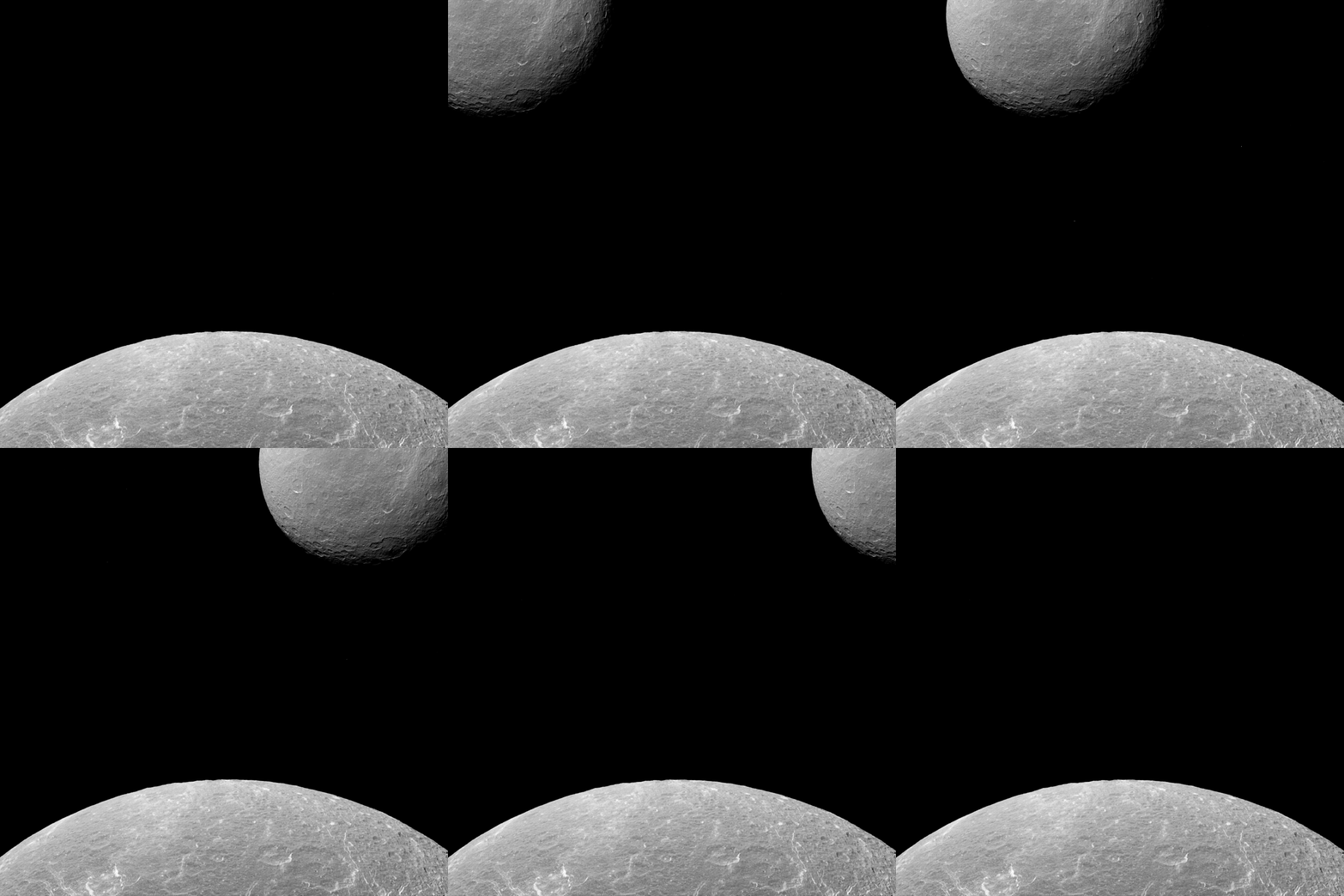
Dione Dwarfing Rhea

Jet Propulsion Laboratory https://www.jpl.nasa.gov/ June 1, 2015
NASA's Cassini spacecraft captured this image when Dione was closer to its camera, making the moon appear much bigger than her larger sister moon, Rhea.

Click here for animation of PIA18319
Click for larger animation

Is Dione (698 miles or 1123 kilometers across) suddenly larger than Rhea (949 miles or 1527 kilometers across)? No, of course not. Cassini simply captured an image when Dione was much closer to the camera, making the moon appear much bigger than her larger sister moon.

Besides their beauty, images like these can help Cassini's navigators determine exactly where the spacecraft is and confirm that it is on course.

This view looks toward the trailing hemisphere of Dione. North on Dione is up. The image was taken in visible light with the Cassini spacecraft narrow-angle camera on April 11, 2015.

The view was obtained at a distance of approximately 68,000 miles (110,000 kilometers) from Dione and at a Sun-Dione-spacecraft, or phase, angle of 29 degrees. Image scale at Dione is 2,165 feet (660 meters) per pixel. Rhea was 300,000 miles (500,000 kilometers) away at a phase (Sun-Rhea-spacecraft) angle of 30 degrees. The image scale at Rhea is 2 miles (3 kilometers) per pixel.

The Cassini mission is a cooperative project of NASA, ESA (the European Space Agency) and the Italian Space Agency. The Jet Propulsion Laboratory, a division of the California Institute of Technology in Pasadena, manages the mission for NASA's Science Mission Directorate, Washington. The Cassini orbiter and its two onboard cameras were designed, developed and assembled at JPL. The imaging operations center is based at the Space Science Institute in Boulder, Colorado.

For more information about the Cassini-Huygens mission visit http://saturn.jpl.nasa.gov and http://www.nasa.gov/cassini. The Cassini imaging team homepage is at http://ciclops.org.

Download JPG
Download TIFF
Mission
Target
  • Dione
Spacecraft
  • Cassini Orbiter
Instrument
  • Imaging Science Subsystem - Narrow Angle
Credit
NASA/JPL-Caltech/Space Science Institute

Keep Exploring

Slice of History - Happy 25th Anniversary, Cassini!

Enceladus in the Infrared (Map View)

Enceladus in the Infrared

Enceladus Global View with Plume (Artist's Rendering)

First Global Geologic Map of Titan

Enceladus Organics on Grains of Ice (Illustration)

Titan's Rimmed Lakes (Artist's Concept)

Texture in the Outer Cassini Division

Embedded Moons Sculpt Saturn's Rings

Mini-jets in the F Ring

About JPL
Who We Are
Directors
Careers
Internships
The JPL Story
JPL Achievements
Documentary Series
JPL Annual Report
Executive Council
Missions
Current
Past
Future
All
News
All
Earth
Solar System
Stars and Galaxies
Eyes on the News
Subscribe to JPL News
Galleries
Images
Videos
Audio
Podcasts
Apps
Visions of the Future
Slice of History
Robotics at JPL
Events
Lecture Series
Speakers Bureau
Calendar
Visit
Public Tours
Virtual Tour
Directions and Maps
Topics
JPL Life
Solar System
Mars
Earth
Climate Change
Exoplanets
Stars and Galaxies
Robotics
More
Asteroid Watch
NASA's Eyes Visualizations
Universe - Internal Newsletter
Social Media
Accessibility at NASA
Contact Us
Get the Latest from JPL
Follow Us

JPL is a federally funded research and development center managed for NASA by Caltech.

More from JPL
Careers
Education
Science & Technology
Acquisition
JPL Store
Careers
Education
Science & Technology
Acquisition
JPL Store
Related NASA Sites
Basics of Spaceflight
NASA Kids Science - Earth
Earth / Global Climate Change
Exoplanet Exploration
Mars Exploration
Solar System Exploration
Space Place
NASA's Eyes Visualization Project
Voyager Interstellar Mission
NASA
Caltech
Privacy
Image Policy
FAQ
Feedback
Version: v3.1.0 - 409b2d2
Site Managers:Emilee Richardson, Alicia Cermak
Site Editors:Naomi Hartono, Steve Carney
CL#:21-0018